Specialist Blogs

Mme. Stella: https://stjudesfrench-stella.blogspot.com

Mr. Oliver: https://mrolivermusicclass.blogspot.com

Mr. Orr: https://tysonorr.blogspot.com

Tuesday, 6 November 2018

Tuesday November 6, 2018

Tremendous Tuesday!

Today we learned about equivalent ratios during math class. Ratios are used for comparisons. They are used to compare two quantities.
Sometimes it is useful to write a ratio in another way. For example, there are 8 cups of strawberries added to a fruit salad for every 16 cups of other fruits. This is an 8:16 ratio of strawberries to other fruits. However, it can also be represented as 1 :2. So if we add one cup of strawberries we can add two cups of other fruits and keep the same mixture in a smaller amount.


 This is an example of scaling up by a scale factor of 3. The ratio 2 : 3 is the same as the ratio of 6 : 15.


This is an example of scaling down by a scale factor of 5. The ratio 8 to 11 is the same as the ratio 40 : 55.

Here, we scaled up by a factor of 8 to create two equivalent ratios.

We can make a string of equivalent ratios by continuing to scale up or scale down.
1 : 3 = 2 : 6 = 3 : 9 = 4 : 12 = 5 : 15 = 6 : 18 = 7 : 21....

All of these ratios show the same relationship.

Simplifying ratios to the simplest form can be helpful when solving problems that deal with ratios. You can simplify a ratio the same way that you simplify a fraction. This is basically just scaling down until you can no longer scale down anymore.

Ms. Jaskolka gave us questions related to ratios and simplifying ratios in groups and then individually to show our understanding of scaling up and down ratios. 

Then we had French.

Next, we worked on our electric cars. Science Fair is next Thursday.

After first recess and lunch we were give a challenge to build a glider. We were given instructions on how to build a glider and then we tested what would happen if we changed some of the characteristics of the plane: both flap up, both flaps down, one flap up and one flap down, adding weight using a paperclip, and then we further tested our paper airplane to see how it could be the best flier. For homework we are writing a report based on todays findings. 


We then worked on our Ontario writing assessment and Polar expressions entry.

After second recess and lunch we had physical education.

Homework:
1.Read Daily
2. Math sheets
3. Finish airplane package 

Monday, 5 November 2018

Monday November 5, 2018

Magnificent Monday!

We began the day with math. We learned about ratios and that a ratio can be used to compare
parts of a whole and one part of a whole to another part of the whole.

Then we had French.

After first recess and lunch we continued writing the Ontario writing assessment choosing to write a fable or a legend. 

Then we had Music.

When we returned, we wrote our test on Bernoulli’s principle and how it relates to how planes fly.

After second recess and lunch we constructed our own paper airplanes based on our current understanding of flight and tested them at 3 ‘airports’. We tried to see if our plane could fly 5 metres, if it would do tricks and if it could glide closely to a target. We then determined which ‘airport’ our paper airplane performed the best and then looked at the similarities between all the paper airplanes at that ‘airport’ to see what they have in common. 


At the end of the day we had a conversation about the importance of always being kind to those around us. 

Homework:


1.    Read Daily.

Friday, 2 November 2018

Friday November 2, 2018

Fabulous Friday!!

We began the day with Math. We reviewed conversion rules between cm-metres-kilometres; millilitres-liltres; grams-kilograms.  
The skills we need for our upcoming unit on rates and ratios is being able to find the GCF and LCF and conversion rules. 

Next we worked on our OWA writing a fable or a legend about how an animal came to be or how it got one of its unique features. 

Then we worked on our electric cars. We are testing our car to see how far it is able to go and then trouble shooting any problems we come across.

After first recess and lunch we reviewed Bernoulli’s principle: an increase in the speed of moving air or a flowing fluid is accompanied by a decrease in the air or fluid's pressure.

We went over our notes on Bernoulli’s and drew a diagram to explain Bernoulli’s principle. 


What is the shape of an airfoil?

An airfoil aerofoil is the cross-sectional shape of a wing, An airfoil-shaped body moved through a fluid produces an aerodynamic force.


What is the direction of the plane and the airfoil?

The plane and the airfoil are both moving forward together. The plane and the airfoil move in the same directions 

What is the distance air travels over and under the airfoil?

The air that goes over the airfoil is travelling over a greater surface area and therefore has a greater distance to travel. The surface area is lesser at the bottom of the airfoil and therefore has a lesser distance to travel. 

What is the direction of airflow over the airfoil?

The direction of airflow is backwards relative to the plane.

What is the speed above and below the airfoil?

The speed above the airfoil is quicker than the air below the airfoil. 

What is the air pressure above and below the airfoil?

The air pressure is lower at the top of the airfoil and higher at the bottom of the airfoil. 

What is the direction of lift?

Since particles flow from high pressure to low pressure the direction of the lift is going up. 


Video to help. Feel free to look for your own videos also! 


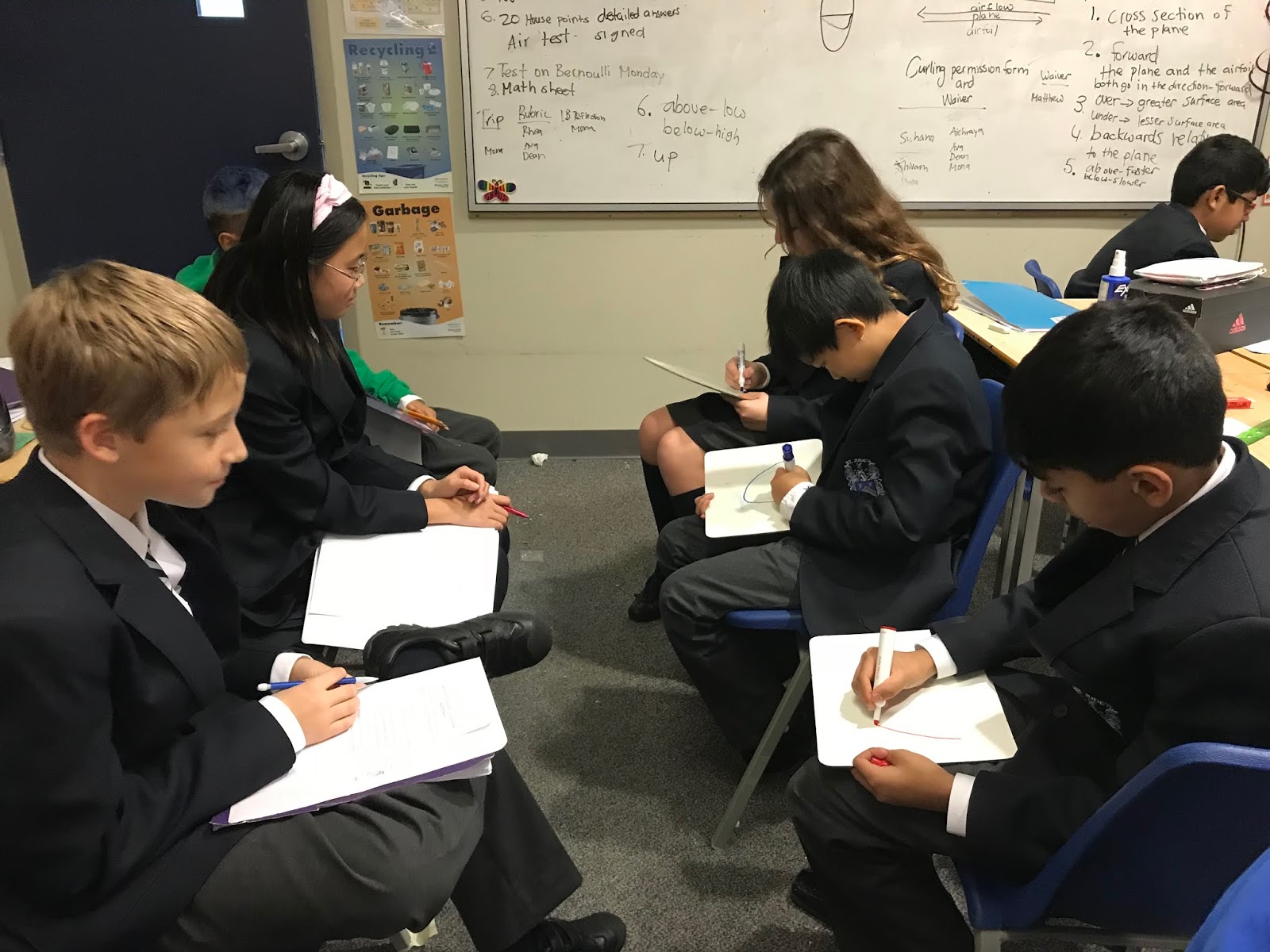
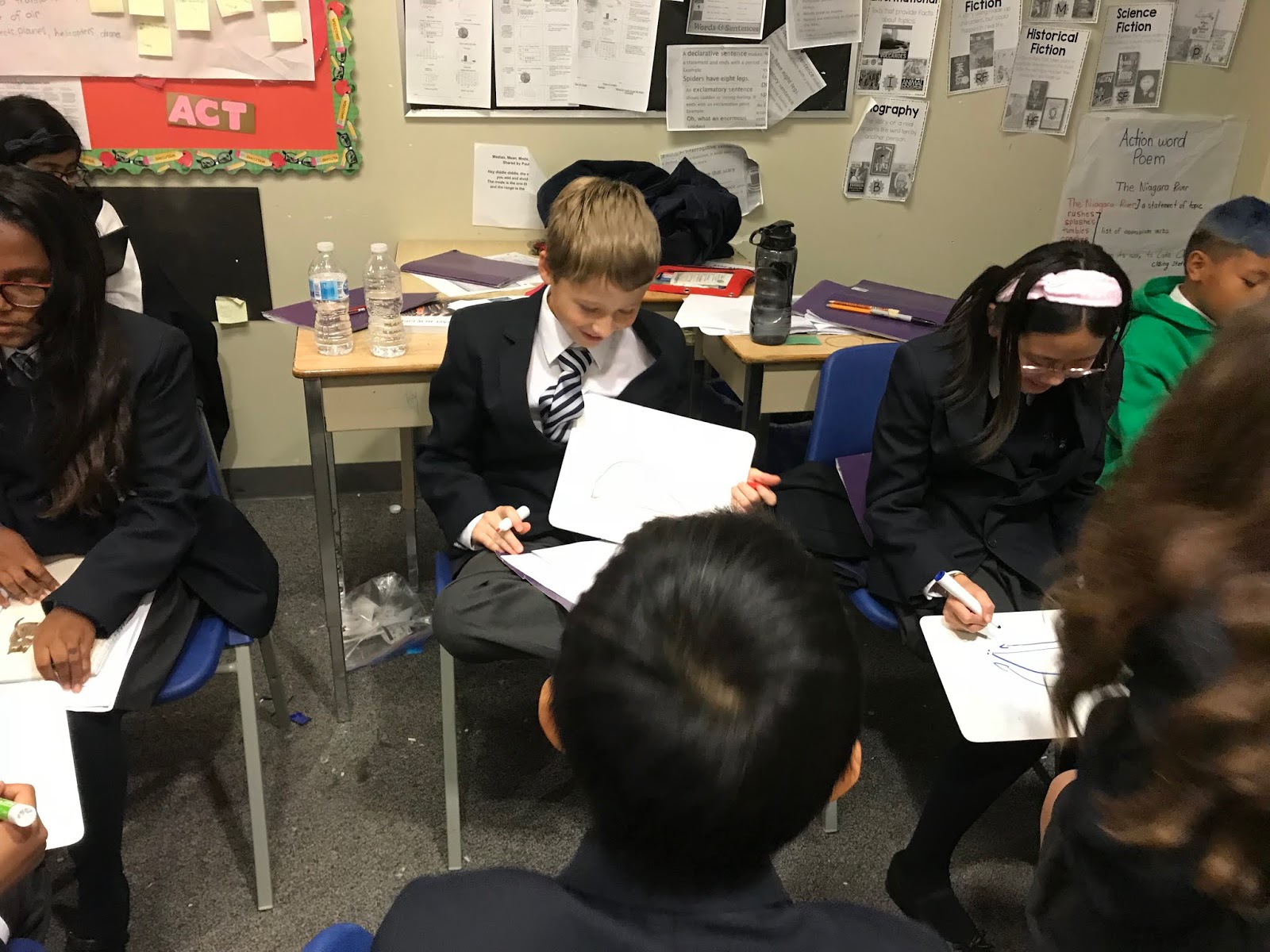
Students completed a carousel activity where students took turns explaining Bernoulli’s principle and drawing a diagram that related to their explanation. Kids teaching other kids really helps students understand the concept learned!!!!


Have a wonderful weekend!

Homework:

1. Read Daily
2. Math sheet
3. Complete sheet - making notes on Bernoulli's Principle related to flight
4. Bernoulli test on Monday 
5. French homework
6. Music presentation on Monday 
7. Fable or legend due on Monday 

Thursday, 1 November 2018

Thursday November 1, 2018

Tremendous Thursday!

We began the day with Math. Before we begin our new unit on Rates and Ratios we need to begin with skills we need to know. We know to know how to find the GCF and LCM when given a set of numbers. Today we learned how to use a factor tree to help us find the GCM and LCM of a set of numbers. Students picked up this method very quickly! We were even challenged to find the LCM and GCF for three numbers and we were able to do so using the factor tree method!

Next we had French.

After first recess and lunch, we looked over out Air test and put in our corrections. Students are to get their test signed and bring them back tomorrow.

Then we had Music.

Next we began writing our Ontario Writing Assessment. We are writing a fable to a legend about how an animals was created or how an animal got its specific characteristics. 


After second recess and lunch, we dove into UOI. We reviewed our research about Bernoulli’s principle. 
Here is a video that helps to explain how the activity that we did with the ping pong ball and funnel and why the ping pong ball stayed in the funnel instead of coming out and how it relates to why planes fly:


More of an explanation on Bernoulli’s principle.

https://easyscienceforkids.com/bernoullis-principle-for-kids-video/


Notice that the air flow is going the opposite direction of the plane. 
During class we reviewed Bernoulli’s principle and how it related to the experiments we did yesterday.

Students are asked to try and write their own notes tonight on using Bernoulli’s principle to explain how an airfoil works. We reviewed all the important considerations today in class. 

Homework:
1. Read Daily
2. Notes on Bernoulli’s principle and diagram 
3. Test on Bernoulli’s principle on Monday
4. Math sheet on GCF and LCM (many finished in class)
5. Curling permission and waiver form due tomorrow 
6. Air test signed