Specialist Blogs

Mme. Stella: https://stjudesfrench-stella.blogspot.com

Mr. Oliver: https://mrolivermusicclass.blogspot.com

Mr. Orr: https://tysonorr.blogspot.com

Tuesday, 3 December 2019

Tuesday December 3, 2019

Tremendous Tuesday!

We began our day with math. 

Learning Goals: Students will learn how to divide numbers with decimals.

Basic long division. à 2668 ÷ 29

           92
29 | 2668
      -261   à 29 x 9 = 261
           58 à Carry down the 8
          -58 à 29 x 2 = 58
             0 R

We learned that division of decimals is just like division of whole numbers, only with a decimal.

Let’s take 26.68 ÷ 2.9. First, we need to round and estimate.
26.68 à 27 & 2.9 à 3
27 ÷ 3 = 9, so we know the answer will be around 9.

We do long division to find the answer, but first remove the decimals and make each number a whole number. 

               9.2 
290 | 2668.0à place the decimal at the end of the number you are dividing into 
        -2610  à    290 x 9 = 2610
              580  à Carry down the 0
             -580 à 290 x 2 = 580
                  0 R

Now we need to add the decimal back. There are a couple of possible answers: 0.92, 9.2, or 92. Since 9.2 is closest to 9, we can assume (based on our estimate) that 9.2 is the correct answer. 


Next, we moved onto our novel study for the term. We first discussed what kind of elements we think we could come across since Tuck Everlasting is a fantasy book. Students thought that we could come across talking animals, potions, magic, witches and wizards, and events that don't seem possible in real life. Then we talked about the prologue, chapter 1 and 2 of Tuck Everlasting. 

After first recess and lunch we had French and then we went to the dome to practice for Christmas concert. 

Then we explored different theories and perspectives as to how the First People came to North America. We talked about various creation stories, the Bering Land Bridge theory and even how some scientist believe we all came from Africa!  

We continued to read about the Beringia Land Bridge theory and worked on an activity to show our understanding.

Students are asked to watch the following videos to gain a better understanding of the Beringia Land Bridge theory:

Bering Land Bridge Migration Theory on YouTube
https://www.youtube.com/watch?v=K3kmVZGGaHg&list=PLTR0ZK8hAD5bOVxhkJ2G1H2Qp3uhRvkeA&index=3

Beringia and the First Peoples: https://www.youtube.com/watch?v=K3kmVZGGaHg&list=PLTR0ZK8hAD5bOVxhkJ2G1H2Qp3uhRvkeA&index=3


Homework:

1. Read Daily
2. Memorize lyrics for Christmas concert
3. Novel study: read chapters 3 and 4 and complete pages 13-19 in novel study package
4. Math pg. 151-152 Questions 1, 2, 3, 6, 9, 10, 12


Monday, 2 December 2019

Monday December 2, 2019

Marvellous Monday!


Thank you so much for all the well wishes and support during this time! I appreciate all of the kindness that has been shown towards me!!! I feel very lucky to have such a caring and wonderful class!


We began the day working on student led conferences. Students reflected on everything that we have learned in term 1 and all the activities that we have done and wrote about their strengths and areas of improvement and then came up with goals and an action plan of how they will work on their goals in the second term.

Then we moved onto our new novel study, Tuck Everlasting! We went through the prologue, chapter 1 and chapter 2.

We also began our new UOI: Where we are in place and time

Central Idea: Exploration has changed and will continue to change people’s lives. 
Concepts: Causation, Change, Perspective
Related Concepts:
Adaptation, Truth, Impact
Lines of Inquiry:
·  First Peoples and their interaction with the environment 
·  The evidence of early explorers 
·  The various groups and communities that make up Canada’s identity

We worked on a diagnostic about our first unit and reading and answering questions related to our novel study. 

After second recess and lunch we joined Mrs. Haag's class and we investigated creation stories  and thought about the Aboriginal perspective of how the earth came to be. We read three creation stories explained by various Aboriginal groups. We worked in groups to discuss the symbols, the explanation of the world, the moral and the items from nature.


Students are encouraged to think and discuss with their famalies their own creation stories as well as what they think is meant by “Canadian Identity” and where they fit in that identity.


Homework:

1. Read Daily
2. Novel study (prologue, chapter 1 and 2) - most finished in class
3. UOI diagnostic questions - most finished in class
4. Math Quiz signed
5. Finish reflections on air show summative - ensure graphs are included
6. Memorize lyrics for Christmas concert
7. Christmas concert is on December 17

Friday, 8 November 2019

Thursday November 8, 2019

Tremendous Thursday!

Dear St Jude's,

November 13th is World Kindness Day! This year, Oakwood will be making a Rainbow Chain of Kindness to hang throughout the school. For $2, students will receive three rainbow links as well as have the option to dress casual for the day. Oakwood staff will hand out the rainbow links Tuesday afternoon, and pick them up throughout the day on Wednesday along with the donations. Please feel free to print the attached letter and send home to your parents or post on your blog. 

If you have any questions please contact Erica ebrunet@oakwoodacademy.ca  or Razia raziz@oakwoodacademy.ca 


We began the day writing our math test and then moving onto our electric cars.

After first recess and lunch we had French.

Then we learned more about how to write a Fable and a Legend.

After second recess and lunch we continued working on our electric cars and reflecting on the enginerring process.

Homework:

1. Read Daily

2. Finish Science Fair duo tang

Wednesday, 6 November 2019

Wednesday November 6, 2019

Wonderful Wednesday!

We began the day taking up our math review for our unit Measurement and Geometry .

Then we discussed how to make a paper plane fly high, far, and straight and we related this understanding to our learning for today.
 

In partners we inquired about the differences and similarities between birds/insects and a plane, the four forces of flight and the motions of a plane.

Motions of a plane:

pitch (the up and down movement of the nose of the plane), roll (motion where one wing top moves while the other wing tip moves down, causing the body of the plane to roll), Yaw (side to side movement of the nose of the plane).


https://www.youtube.com/watch?v=5ltjFEei3AI&t=16s (understanding the four forces of flight) 


https://www.youtube.com/watch?v=JSIPr9kcxdA (understanding roll, yaw, and pitch)

https://www.youtube.com/watch?v=YyeX6ArxCYI (How planes fly)

https://www.youtube.com/watch?v=2tdnqZgKa0E (How a helicopter flies) 

Then we learned more about fables and legends and the important elements needed to write each one. We read examples to become more familiar with how to write a fable and legend and then added to our success criteria for each one.

Next we worked on our electric cars. Students are making so much progress!!!!!

After first recess and lunch we had French.

Then we continued working on our electric cars.

At the end of the day we had physical education.

Homework and reminders:

1. Read Daily
2. Math test tomorrow
3. Finish questions about the four forces of flight 
4. No school Friday and Monday 

Tuesday, 5 November 2019

Tuesday November 5, 2019

Tremendous Tuesday!

We began the day reciting poems for Guy Fawkes day during assembly.

Then we had Music.

Next, we took up our homework on volume. Then we worked on our math review.

After first recess and lunch we had French.

Next, we were give a challenge to build a glider. We were given instructions on how to build a glider and then we tested what would happen if we changed some of the characteristics of the plane: both flap up, both flaps down, one flap up and one flap down, adding weight using a paperclip, and then we further tested our paper airplane to see how it could be the best flier. For homework we are writing a report based on todays findings. 


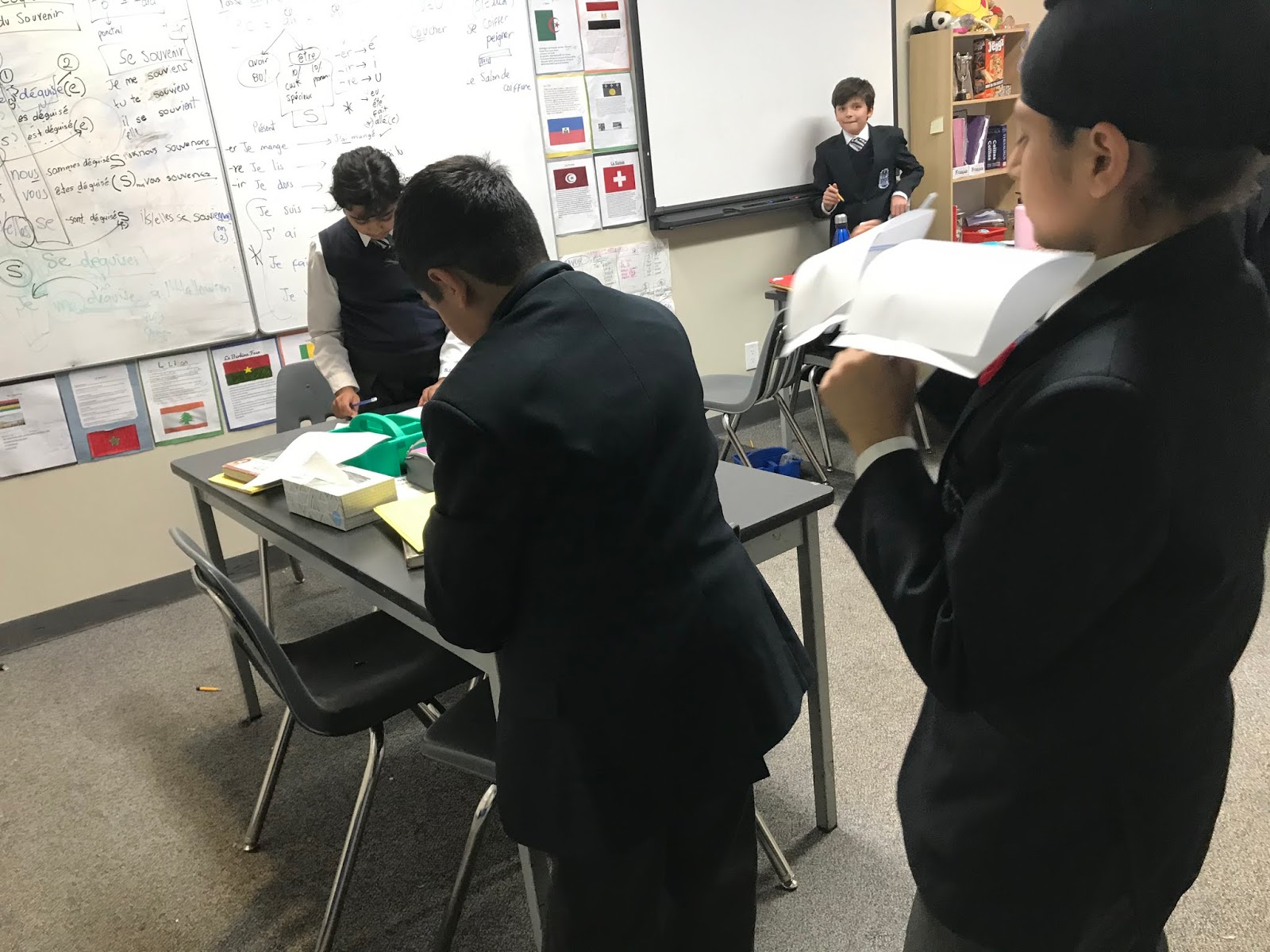
Then we learned about Fables and Legends. Our Ontario Writing Assessment this term is based on fable and legend writing. We first determined what is a fable and what is a legend. Then we were given two examples, and we needed to figure out if it was a fable or a legend and once we figured this out, we discussed in partners how the example used the elements of a legend or fable. Students then came up with the success criteria as to how to write a successful legend and a successful fable.

At the end of the day we worked on our electric cars. 


Homework:

1. Read Daily
2. Math Review
3. Finish report on glider 

Monday, 4 November 2019

Monday November 4, 2019

Marvellous Monday!

We began the day taking up our math homework and checking our understanding about surface area.

Our learning goal for today: Finding the volume of a Rectangular prism using the formula 

l=length
w=width
h=height
A=Area 


We came to understand that volume is the the amount of space it fills measured in cubic units. 

Volume of a rectangular prism = base area x h 

V=lw x h 
V = A x h
V= Ah

We then worked on questions related to volume; we used snap cubes to better understand volume as the amount of space the object takes up.


Success Criteria:

I am able to find the volume of a rectangular prism using the formula Volume of a rectangular prism = base area x h 
V=l x w x h
V=lw x h 
V = A x h
V= Ah
-I can answer problem solving questions related to volume 


Then we wrote our test on Bernoulli’s principle and how it relates to how planes fly.

After first recess and lunch we had French.

Then we constructed our own paper airplanes based on our current understanding of flight and tested them at 3 ‘airports’. We tried to see if our plane could fly 5 metres, if it would do tricks and if it could glide closely to a target. We then determined which ‘airport’ our paper airplane performed the best and then looked at the similarities between all the paper airplanes at that ‘airport’ to see what they have in common. 


At the end of the day we had physical education.

Homework:

1. Read Daily
2. Math pg. 102-103 Questions 1, 2 (pick 1), 3, 4, 5, and 8

Friday, 1 November 2019

Friday November 1, 2019

Fabulous Friday!

Can you believe it is already November!! How time flies!!


For our upcoming Christmas concert, our class will be doing a scene from Charlie' Brown's Christmas. If students are able to find the movie online, they are encouraged to watch it. We will be doing a scene and singing a song. The link below will be the song that we will all sing as a class. Students are asked to start practicing.

https://www.youtube.com/watch?v=ha8kgByvWh0


We began the day with Music.

Then we reviewed Bernoulli’s principle: an increase in the speed of moving air or a flowing fluid is accompanied by a decrease in the air or fluid's pressure.

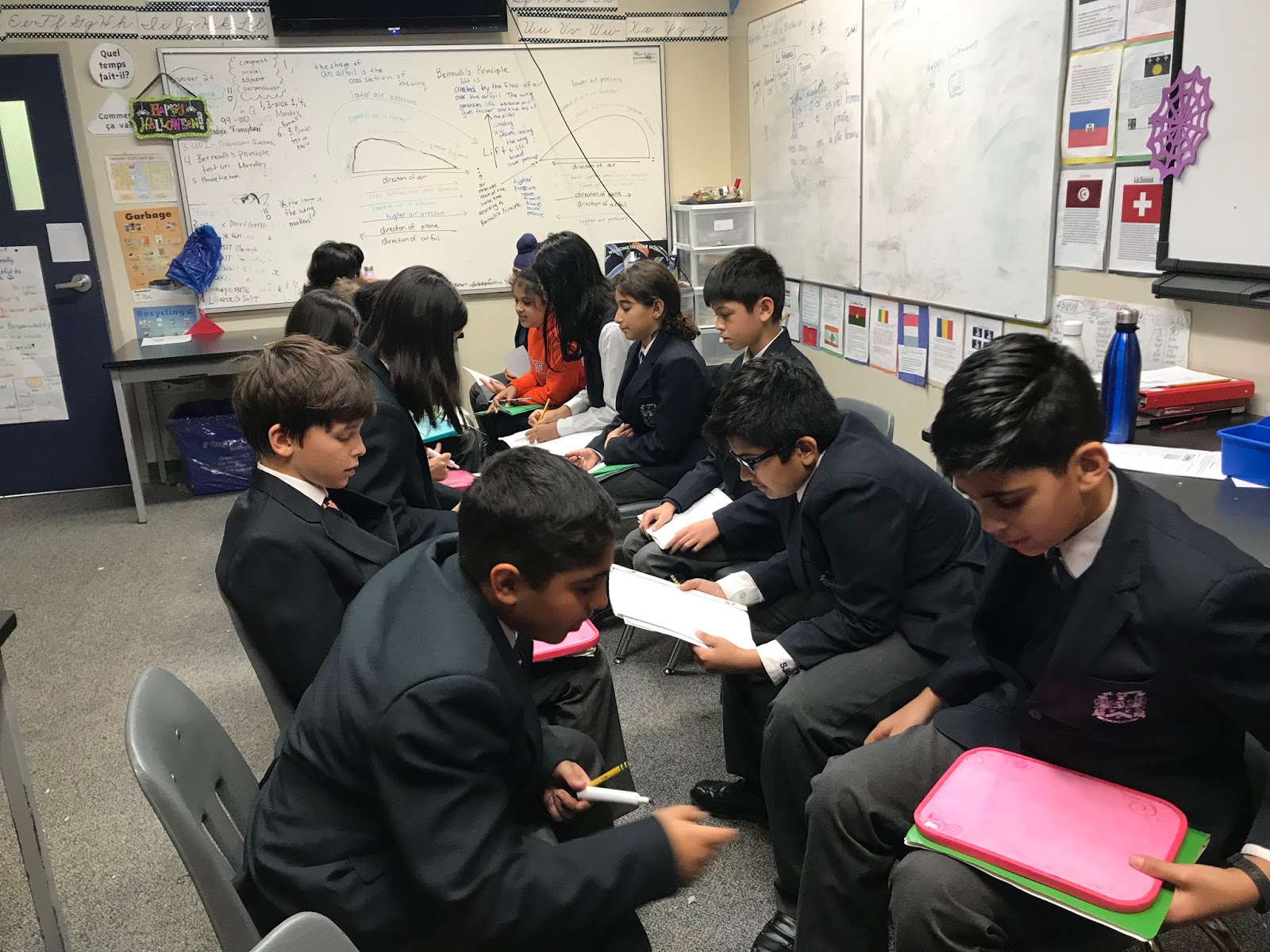
We went over our notes on Bernoulli’s and drew a diagram to explain Bernoulli’s principle. Students participated in a carousel activity where they had an opportunity to explain Bernoulli’s principle and get peer feedback as well as listen to a peer explain Bernoulli’s principle and provide feedback for them. 


What is the shape of an airfoil?

An airfoil aerofoil is the cross-sectional shape of a wing, An airfoil-shaped body moved through a fluid produces an aerodynamic force.


What is the direction of the plane and the airfoil?

The plane and the airfoil are both moving forward together. The plane and the airfoil move in the same direction.

What is the distance air travels over and under the airfoil?

The air that goes over the airfoil is travelling over a greater surface area and therefore has a greater distance to travel. The surface area is lesser at the bottom of the airfoil and therefore has a lesser distance to travel. 

What is the direction of airflow over the airfoil?

The direction of airflow is backwards relative to the plane.

What is the speed above and below the airfoil?

The speed above the airfoil is quicker than the air below the airfoil. 

What is the air pressure above and below the airfoil?

The air pressure is lower at the top of the airfoil and higher at the bottom of the airfoil. 

What is the direction of lift?

Since particles flow from high pressure to low pressure the direction of the lift is going up. 
In other words, lift is created by the flow of air over the airfoil. The wing generates lift because air goes faster over the top of the airfoil creating low pressure, causing the wing to lift toward lower pressure since higher pressure wants to move towards lower pressure. 


After first recess and lunch we had French.

Then we finished writing our book reports for The City of Ember.

We spent the rest of the days working on building, testing and troubleshooting our electric cars.

Have a great weekend!

Homework:

1. Read Daily
2. French
3. Math pg 99-100 (Question 1, 3 - pick 1, 4, 5 (I provided for students), 8 - pick 1) - most students are finished
4. Math review sheets
5. Study for test on Bernoulli's Principle on Monday